
Accessibility Plan
Regina Catholic School Division Accessibility Plan 2025-2028
RCSD Accessibility Plan Download
The Regina Catholic School Division Board of Education has established this accessibility plan in consultation with its stakeholders, and within the framework of our vision, mission and core commitments.
Table of Contents
Regina Catholic Schools believes that every person who walks through our doors should feel seen, valued, and supported. When we remove barriers, we honour the dignity of each individual and strengthen the fabric of our community.
Rooted in our belief that every person is created in the image of God, we are dedicated to ensuring that students, staff, families, and visitors are able to learn, work, and share their gifts in environments that are welcoming and accessible. This plan outlines the actions we are taking to open pathways, build understanding, and nurture a true sense of belonging for all.
The heart of this work has been shaped by the people we serve. Through meaningful conversations with students, families, employees, and community partners, we have listened to lived experiences, challenges, hopes, and insights. We are deeply grateful for the honesty, trust, and wisdom that has guided us.
As we move forward, we do so together with a shared commitment that accessibility is not simply an obligation, but a reflection of our faith, our mission, and our belief that every person deserves the opportunity to thrive. Each step action brings us closer to a community where everyone belongs, and where inclusion is lived out every day.
Ryan Bast, Board Chair
Kelley Ehman, Director of Education
The Regina Catholic School Division (RCSD) has developed this Accessibility Plan in consultation with stakeholders and within the framework of our vision, mission, and core commitments. RCSD has 32 schools, serving over 14,000 students and employing more than 1,600 staff members, each contributing to a vibrant and diverse learning community. This plan reflects RCSD’s ongoing commitment to fostering learning and working environments that are welcoming, inclusive, and accessible to all.
In accordance with the Accessible Saskatchewan Act, which came into effect on December 3, 2023, RCSD is committed to identifying, removing, and preventing barriers that impact individuals who learn, work in, or visit our facilities. The Act requires all public sector organizations to develop and publicly share an accessibility plan by December 3, 2025. These plans must be created in consultation with persons with disabilities and grounded in principles such as inclusion, adaptability, and universal design. RCSD’s three-year accessibility plan outlines the actions we will take to enhance accessibility and equity across the division.
Accessibility is central to who we are as a Catholic school division. We recognize the inherent dignity of every person and our responsibility to ensure that nothing stands in the way of meaningful participation in our schools, programs, and services. When we work to remove barriers, we honour the God-given gifts of each individual and build a stronger, more connected community.
Our commitment to accessibility for all is guided by the Saskatchewan Human Rights Code, which protects the rights of every person and by the Truth and Reconciliation Commission’s Calls to Action, which urge us to strive toward culturally responsive and inclusive solutions.
The RCSD Accessibility Planning Committee began its work in early 2025 by identifying a team lead, creating a project timeline, identifying stakeholders, and developing an engagement process. In September 2025, an accessibility survey was developed and, in October 2025, shared with community partners, families, students, and employees. The Accessibility Planning Committee reviewed the survey findings in November 2025, along with qualitative feedback from staff, students, families, and 18 community organizations. These insights helped identify areas of strength, opportunities for improvement, and priorities for action. Through this collaborative process, we examined existing programs and services, celebrated the progress made to date, and identified new opportunities to better serve our community.
RCSD extends sincere appreciation to everyone who contributed to this important work. Together, we continue to build a Catholic education system where every person feels valued, supported, and able to participate fully because inclusion is not just what we do, but who we are.
Through our Accessibility Survey and community engagement process, Regina Catholic School Division gained meaningful insights from staff, students, families, and 18 community partners. This strong participation reflects a shared commitment to fostering accessibility and inclusion across our division.
The feedback revealed five key themes:
An encouraging 76% of respondents found RCSD communications clear. Many emphasized the need to further enhance visible and accessible information or learning opportunities about accommodation and accommodation requests. Suggestions included expanding inclusive communication options such as American Sign Language (ASL), printed materials, captioning, and translated materials.
Respondents shared insights into enhancing physical accessibility including elevator access, seating supports, and playground design. There was strong support for proactive infrastructure planning, provincial and municipal advocacy, and regular facility audits to foster safe, inclusive spaces.
Nearly half (49%) of participants highlighted the importance of strengthening support services, such as early assessments, access to speech therapy, and timely identification of student needs. Continued expansion of specialized programs like English as an Additional Language (EAL) and Elementary Intensive Supports Classrooms (EISC) was encouraged to meet the needs of diverse learners highlighting the continued need for provincial and municipal advocacy.
There was strong support for neurodiversity affirming training and broader inclusion education for all staff. Respondents emphasized that deeper understanding, not just procedural and operational protocol, is key to advancing accessibility.
Feedback reflected pride in RCSD’s inclusive efforts, and highlighted opportunities for more consistent application of accessibility values and understanding across schools and work environments. A division-wide culture of belonging, dignity, and respect remains a central goal.
The Accessible Saskatchewan Act defines a barrier as anything that hinders or challenges the full and equal participation in society of persons with disabilities.
There are many types of barriers that persons with disabilities may experience, including physical barriers, information and communications barriers, and attitudinal barriers. Definitions and examples of each barrier type are outlined below to help people understand the experiences of people with disabilities.
Physical barriers exist when spaces are designed in ways that prevent or limit mobility or access.
Examples of physical barriers:
- Hosting public events at a venue that is only accessible by stairs.
- Parking lots with no curb cuts, making it difficult to access sidewalks.
- Washrooms that lack accessible stalls or automatic door openers.
- Access to increased privacy spaces to accommodate individual needs.

Information and communications barriers exist when information or material is shared in a way that is not accessible to all people.
Examples of information and communication barriers:
- Using small print or fonts that are difficult to read.
- Websites and documents that are not accessible for screen readers or convert text to multiple languages.
- Videos that do not have closed captioning.
- Access to alternative and augmentative communication tools.
- Signs that include text without supporting symbols or pictures.
Attitudinal barriers exist when people act or think based on false assumptions.
Examples of attitudinal barriers:
- Not including persons with disabilities in decisions that impact them.
- Making assumptions about a person’s ability and/or having a bias or unconscious bias.
- Avoiding a person with a disability for fear of offending them.
Regina Catholic School Division has taken steps to improve the accessibility of division facilities, programs, and services. However, we recognize that progress will be ongoing as we aim to become more inclusive. This plan outlines the actions that the school division will prioritize over the next three years to remove accessibility barriers that persons with disabilities experience. Division staff will work together to complete the actions outlined in this plan and raise awareness about accessibility.
Regina Catholic School Division will work to strengthen accessibility awareness, communication practices, and inclusive culture across all schools and departments. RCSD will aim to have clear pathways to available supports and services for students, families, and employees. By promoting accessibility awareness and reducing stigma, the Division will foster a culture rooted in human dignity, respect, and belonging for all.
- Professional development for staff to improve accessibility of division and school communications.
- The appointment of a division Diversity, Equity, Inclusion, and Accessibility Lead position.
- The division has established, and continues to strengthen, a partnership with the Archdiocese of Regina to ensure that the Catholic Social Justice Teaching of the dignity of the human person is reflected in all that we do.
- The Diversity, Equity, Inclusion, and Accessibility Working Group has reviewed and strengthened Board policies to support a more inclusive and equitable division.
- Inclusive practices training for all Instructional Assistants focused on inclusion, human dignity, disability affirming language, use of visual supports, and augmentative and alternative communication.
- Host an Inclusion Fair for students, their families, and our staff to come together and learn more about community supports and connections.
- The Diversity, Equity, Inclusion, and Accessibility Working Group will review and strengthen division Administrative Applications to support a more inclusive and equitable division.
- Continued professional development for creating accessible digital communications.
- Augmentative and Alternative Communication (AAC) parent/guardian training offered both in-person and via recorded video, with closed captioning in English and additional languages.
- Ongoing professional development led by Children’s Autism Services of Edmonton.
- Ongoing inclusive practices training for staff.
Regina Catholic School Division will continue to identify and reduce physical barriers across facilities and properties to create safe, accessible, and welcoming environments for everyone. The Division will conduct accessibility audits, prioritize advocacy for improvements through the Preventative Maintenance and Renewal (PMR) Program. RCSD will embed accessibility standards in all new builds and renovations to create equitable access for all students, staff, and visitors.
- Accessible door push buttons.
- Doorbell communication systems to allow easier access to our facilities.
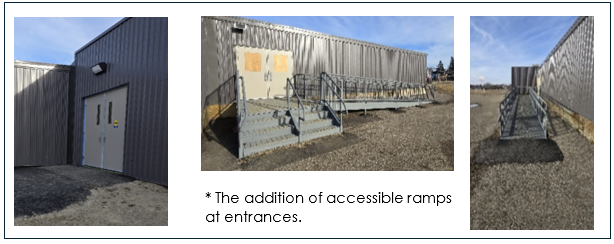
- Installed ramps for accessible entrances. *
- Constructed barrier free and increased privacy washrooms.
- Audits of facilities to improve accessibility.
- Research options that improve accessibility.
- Include accessibility considerations in design, construction, and building improvements. (Example: facility layouts, washrooms, entrances, sidewalks, ramps).
- Continue to improve signage that is accessible for all users.
- Review accessible parking and work with local authorities regarding on-street accessible parking at division facilities.
- Classroom implementation of Universal Design for Learning (UDL) principles to offer flexible instruction that reduces barriers.
- Explore opportunities to create flexible learning spaces that incorporate quiet spaces, sensory tools, adaptable furniture, and varied lighting and acoustics to better support sensory needs.
- Implement technology to include built-in accessibility tools, reducing the need for individual requests.
Regina Catholic School Division is advocating and taking steps to remove accessibility barriers that limit access to division programs and services. This includes streamlining assessments and accommodation processes, continuing the expansion of specialized programming, enhancing adaptive technologies and assistive services to promote full participation and success for all.
- Employ health care practitioners to assist with planning for medical accommodations within the school.
- Use universal screening tools and instructional resources that support the development of reading skills for those who may be at risk for reading difficulties.
- Use a flexible Tiered Continuum of Supports to guide schools in providing academic, behavioural, and social-emotional supports.
- Addition of Early Learning Intensive Support (ELIS) spaces in all Prekindergarten programs.
- Serve as the Accountable and Staffing Partner with the Regina Early Years Family Resource Centre
- Review early years data to guide equitable support decisions.
- Provision of and training for Alternative and Augmentative Communication (AAC) high-tech devices to support minimally and non-speaking students.
- Collaboration with Children’s Autism Services of Edmonton to strengthen teacher capacity in addressing self-regulation and social-emotional needs.
- Expand access to and training in high-tech Alternative and Augmentative Communication (AAC) devices to support minimally and non-speaking students.
- Development of a guiding document for requesting an accommodation.
- Continued expansion of elementary intensive support programming to allow for students to be supported in their neighborhood school as they enter Kindergarten.
- Expand opportunities for high school students requiring intensive supports with a focus on inclusive practices in school and community.
- Advocacy for adequate funding to enhance accessibility practices and programming.
- Addition of intensive support coach teacher roles.
- Contracted Occupational Therapy and Psychology services.
- Provide all grades 4–8 students with laptops equipped with accessibility tools to ensure equitable access, minimizing the need for individual assistive technology requests and reduce stigma during student use (2025-26).
- Extend one-to-one laptop devices to all students in Grades 9–12 by the 2026–27 school year.
RCSD recognizes that many individuals have varied experiences and exposure to diverse needs. RCSD will build staff capacity, understanding, and confidence to support accessibility and inclusion across all roles and departments. The Division will prioritize inclusive and neurodiversity affirming training, expand opportunities for augmentative and alternative communication learning, and integrate accessibility principles into onboarding and professional development to build understanding, empathy, and inclusive practices division wide.
- Professional development for Board of Education, Executive Council and School Based Administrators, and facilities staff on inclusive language, unconscious bias and microaggressions.
- Professional development for staff working with students requiring intensive supports to enhance knowledge of current best practices to promote inclusion, learning, communication, and social development.
- Training for early learning staff on inclusive practices to support student participation, learning, and social development.
- Teacher and educational support professional training on best practices to support autistic students.
Actions for 2025-28 - Continue professional development in unconscious bias and microaggression for all RCSD staff.
- Expanding staff professional learning for teachers and educational support professionals to support inclusive practices in all schools.
- Diversity, equity, inclusion, and accessibility liturgical group developing inclusive and accessible liturgies and Catholic education .
- Offer continuous training to ensure staff understand and use digital tools which allow language translation, adjustable font size, device screen size adaptations, alternative text, and add closed captioning.
- Regularly assess and improve the accessibility of division and school digital platforms including websites and online services.
- Continue professional development in unconscious bias and microaggression for all RCSD staff.
- Expanding staff professional learning for teachers and educational support professionals to support inclusive practices in all schools.
- Diversity, equity, inclusion, and accessibility liturgical group developing inclusive and accessible liturgies and Catholic education.
- Offer continuous training to ensure staff understand and use digital tools which allow language translation, adjustable font size, device screen size adaptations, alternative text, and add closed captioning.
- Regularly assess and improve the accessibility of division and school digital platforms including websites and online services.
This plan affirms that Regina Catholic School Division has a foundation in accessibility and inclusion, recognizing the dignity of the human person. It also highlights clear pathways for growth – particularly in communication, infrastructure, staff training, and division-wide awareness – underscoring our ongoing commitment to creating welcoming, faith-based environments for all.
Ableism and Disability Oppression: Ableism or disability oppression is the discrimination of and social prejudice against people with disabilities based on the belief that typical abilities are superior. At its heart, ableism is rooted in the assumption that disabled people require 'fixing' and defines people by their disability. Ableism views typical abilities as the norm and devalues people who have physical, intellectual, psychiatric, sensory, or other disabilities.
Accommodation: Any technical aid or device, personal support or disability-related support that a person may require. This can include, but is not limited to, accessible document formats, mobility supports to attend a meeting, interpretation or captioning services, or ensuring space has sensory sensitive features.
Adaptability: The ability to be modified for a new use or purpose. Disability and accessibility are evolving concepts that change as services, technology and attitudes change.
Alternate Formats: Alternate ways of providing information beyond traditional printed material. Examples include large print, text-only documents and Braille.
Alternative Text: Also referred to as alt tags or alt attributes. Alternative text provides a verbal description of a visual or graph for individuals with visual impairments who use screen readers.
Barrier: Anything that hinders or challenges the full and equal participation in society of persons with disabilities.
Captioning: Text at the bottom of the screen (television/video) allows people to follow spoken dialogue and distinct noises. Closed captioning is similar, but the text must be decoded to appear on the screen.
Disability: Any impairment that, in interaction with a barrier, hinders an individual’s full and equal participation in society. Disabilities can be permanent, temporary or episodic in nature, and may or may not be evident. There are many types of disabilities that people experience, including physical, mental, intellectual, cognitive, learning, communication and sensory impairments.
Diversity: Recognizing that each person is unique and has different backgrounds. Diversity means including or involving people from a range of different social or ethnic backgrounds and of different genders, sexual orientations, disabilities, etc.
Inclusion: Providing equal access to opportunities and resources for people who might otherwise be excluded or marginalized, such as individuals with physical or intellectual disabilities and members of other minority groups.
Gender Diversity: Gender diversity encompasses the recognition and celebration of individuals whose gender identities and expressions fall outside of the traditional binary of male and female. It includes transgender, non-binary, and gender-nonconforming individuals, among others.
Large Print: Printed information provided in a large font size (18 pt or larger) for people who have low vision. For easier reading, select “sans serif” fonts.
Neurodiversity: Neurodiversity acknowledges that differences in how brains function are normal variations, not deficits, and embrace the diverse ways people think, learn, and interact with the world.
Plain Language: Clear, conversational communication that makes sense to the intended audience. The goal of plain language is to communicate so clearly that the intended audience can easily find what they need, understand what they find, and use the information.
Self-Determination: People are empowered to make their own choices and control their own lives.
Service Animal: The Saskatchewan Human Rights Commission defines a service animal as an animal with specialized training to assist a person with a recognized physical and/or mental disability.
Universal Design: Universal design means making things safer, easier and more convenient for everyone. It involves a range of design concepts, including design of products, or spaces and environments, to provide access in a way that respects all abilities.
The division values your feedback and welcomes members of the public to submit comments about our accessibility plan using the contact methods below.
Regina Catholic School Division
2550 Sandra Schmirler Way
Regina, SK S4W 1A1
306.791.7200
rcs@rcsd.ca